Showing posts with label Writing. Show all posts

Thursday, June 26, 2014

We Need More Time

I woke up this morning thinking about Google forms and spreadsheets.

Really.

Like most reading teachers I know, at some point during the year I want my students to create and turn in a list of the books that they've read that year. I've done this a variety of ways over the years: handwritten lists, spreadsheets imported from Goodreads, spreadsheets from Google forms.

But that's not what I want to write about today.

As I came more fully awake this morning, and as my brain kept thinking about Google forms and spreadsheets, I had the thought that brought me fully awake: Time spent teaching students to make a Google form is time not spent reading or writing.

I knew this, of course. I'd already had that thought awake, but for some reason my sleeping brain returned to it.

So I'm thinking about time.

I haven't made many decisions about next year, and I'm still waiting for some school-level decisions to be made (like how many periods we will have of humanities next year), but I know that I have to take back control over how we use time in the classroom. Reading and social studies have taken too much time away from writing, and writing needs that time back.

Next year I will most likely have 13 or 14 40-minute periods to teach a combination of reading, language arts, and social studies. (While it's listed as language arts on report cards, I always call it writing.) The 15th period is library.
If I were to add up everything I want to do in a week, and everything I'm mandated to do, and everything my students need, I could easily fill all 45 periods on our schedule each week, including lunch, study hall, and mass. Somehow I don't see that happening.

So how do I find the time? How do I stop to teach a technology skill, valuable and useful though it is, when it takes away from reading and writing? And if I can't find the time, how can English teachers with only one period each day to teach both reading and writing find the time?

So that's what I'm thinking about this morning.

Tuesday, June 17, 2014

SOL: Poolside with Jake Barnes

When I was in high school, I worked as a lifeguard at our local tennis club.

Many of you are no doubt picturing sunglasses, a deep tan, and summer highlights.

You're wrong.

I grew up in Western Washington. Summer arrives there in late July, if you're lucky, and sticks around long enough to make the first few weeks of school miserable. Really, I never assumed that the sun would be out on the 4th of July. I figured it'd be raining.

The pool would open in June, but the crowds would be thin at best. Most of the time would be spent huddled under a beach towel and a hooded sweatshirt, bathing suit on underneath because you had to wear one on duty.

Usually, of course, we sat in the lifeguard chair, but today it was raining. Or drizzling, more likely. It drizzles more than it actually rains in Washington. There were no swimmers at all, so I was sitting under the covered area near the locker rooms, bathing suit, beach towel, sweatshirt, probably a hat. And Ernest Hemingway's The Sun Also Rises.

"You taking Ploof's class next year?" Jeff asks, dropping into the chair next to mine. There aren't a lot of customers for tennis either. Jeff is a year ahead of me at Bellarmine, and I'm friends with his younger sister.

"Yeah," I say, holding up the paperback novel. Junior year is a big deal, academically, and Ed Ploof's American Lit class is an important part of that.

"Huh," Jeff says, leaning back in his chair. We watch the rain drizzle. Or mist. Often it's just misting.

"Whatever you do," he continues, gesturing to the book in my hand, "don't miss what's wrong with Jake. I read right past it, and the book makes no sense without it."

I frown. Don't miss what's wrong with Jake, I tell myself.

"His war injury," Jeff says. "It's important. Pay attention to that."

I nod, already worrying. Don't miss what's wrong with Jake.

And I don't.

Friday, December 13, 2013

Thinking about Place

This year my students will be learning about The Coolest Place You've Never Heard Of. At least, that's what I call the project in my mind.

When I started memorizing all the countries two years ago, I realized that there are many (many many) places on this planet that I had never even heard of. Many are islands, some still governed by a European nation. Others are independent. I wanted my students to learn about these places, but I didn't find a way to approach the subject last year.

Fast forward a year. I've been reading Chris Lehman's Energize Research Reading and Writing. We have an open house for families at the end of January. I'm a bit between revolutions in history. Why not spend some time researching a cool place and turn it into something to share with families in January? (By the way, it was 2 degrees when I started writing this. Just writing about January makes me colder.)

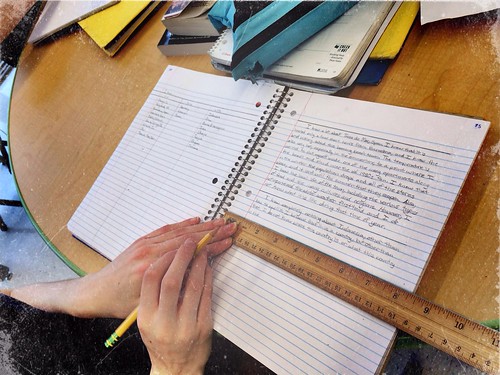
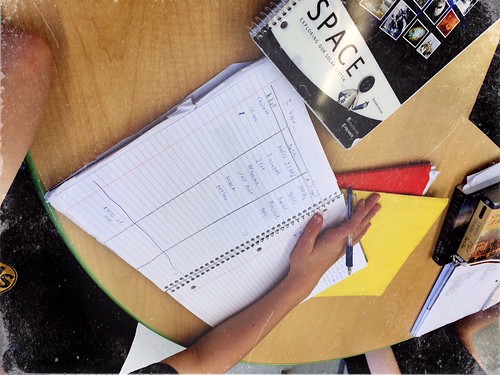
On Wednesday we started thinking about places. It was, coincidentally, another open house, this time for prospective families, so we had our doors open for visitors. I took my idea for this straight from Chris's book. On some chart paper on our easel, I put a simple 3-column chart. I wrote "I know", and then "a lot", "some", and "a little" at the top of each column. I asked students to open to a double-page spread in their social studies notebooks, and to copy the chart on the left page.

Meanwhile, I made my own chart on the SmartBoard. After a minute, I asked them to put down their pencils, and I started filling in my chart. I used it two different ways, both to lists several different places and also to think about what I knew and didn't know about specific places. I gave students five minutes and told them to fill in their thinking sheets as it worked for them.

After five minutes, I asked them to pick one of their places, and write about it quickly on the right page. What do you know? What do you want to know? When you exhaust one topic, either draw a line and pick another one, or go back to your chart if writing has sparked your thinking. I gave them ten minutes to go back and forth between the two pages, and suggested they have 2-3 quick pieces at the end of that time.

When time was up (I let the activity go until everyone had at least two quick writes), I asked them to jot down a list of places that they were curious about after thinking about places. It could be a region or a specific place. At this point I let students spend time looking at the maps on our walls, so they gathered and started pointed out interesting places to each other.

I realized partway through the second class that it would be helpful to refine the statement at the top of the page to "Places I know (a lot, some, a little) about." It's something to remember next time.

I'm not sure where this project will take us. I've told students that I want them to become experts about a place. Some will hunt out the most obscure place possible, and others are curious about places of current significance. The student in the photo above wants to learn about "places of war", names that we have heard on the news but know nothing about. I love that idea.

At this point, I'd like students to have a general idea for their place (or a few contenders) before they leave on break. I won't assign anything specific for this project over the vacation, but I pointed out that most of us have at least one day over break when we're bored enough to do homework. Why not spend it looking up obscure parts of the world on Google Earth?

And if you haven't yet read Chris Lehman's Energize Research Reading and Writing, I highly recommend it. The thinking sheet and writing we did came straight from the book. I'm still in the early chapters, and it's already changing my classroom.

Tuesday, December 10, 2013

How the Lesson Really Went

Last week I wrote about my plans for selecting and revising a scene from our NaNoWriMo novels to include in a class anthology.

As with any lesson, there were changes and improvements along the way. One class finished choosing and started revising last week, and the other just picked their scene yesterday. One class followed the lesson plan pretty closely and the other moved in fits and starts.

That's how classrooms work.

We started seated at our imaginary rug. I reminded them what an anthology is, and said that this year I'm determined to put one together for our novel excerpts. I asked them to make a list of scenes, or moments, from their stories. I said they could even include scenes that they hadn't yet written but were part of their story. I sent them back to their seats to make their lists with their novels open in front of them, and I started my own list.

It was hard. Really, really hard. I'd decided to change my set-up completely, so I didn't want to use any of those scenes. I ended up with a list of scenes that I still needed to write.

This was equally hard for some of my students. Most of us look back on our NaNo drafts with a sense of accomplishment and also a sense that "this is not good." We might love our stories, but we know how much work there is to do before they reach the ideal in our minds.

Many students were also stuck on length. Ask them to pick a conversation between characters, they ask how long it should be. Ask them for a scene about setting, they ask how long it should be. I told them repeatedly that it was irrelevant at this point, but I don't think they believed me. I still refused to answer.

Once we each had at least five scenes, we came back to the rug. I showed them a clip of Donald Graves from Children Want to Write: Donald Graves and the Revolution in Children's Writing by Thomas Newkirk and Penny Kittle. In the clip, Donald Graves shares his list of writing ideas and then asks students to do the same. I shared my list and then asked students to share theirs with the person next to them. After a few minutes of talk we shared our top two with the group, and returned to our computers to locate those scenes in our drafts. We made electronic copies (so they wouldn't be working with their full novel every day) and printed out the pages for our writing folders.

Next step: Remind them again that revising is more than moving the commas around.


Thursday, December 5, 2013

After NaNoWriMo

Every year I have a new plan for how to handle life after NaNoWriMo. We revise excerpts. We pull out dialogue and practice the rules for punctuating it. It's always a battle because we are caught between Thanksgiving and Christmas, fighting against daily distractions in a school that celebrates all month long.

This year we're changing it up again. Students have already turned in their November drafts electronically. This allows me to verify their word count and that they actually write a novel, no matter how bad it is, and not just gibberish. (And yes, once in five years a student has written gibberish. For a month. Sigh.) I won't read these in detail, but I'll make sure they exist.

Next we're going to pick a scene to revise and share. I'm asking students to look through their drafts and pick at least 5 moments, or plot points, that they might like to revise and include in a class anthology. I don't want pages or even words from their drafts yet, just scenes (fight with mom, missing the foul shot, the snowstorm, etc). I'm going to ask them to share their list with classmates, and only then will they actually pull words and pages from their draft.

At this point, our focus will be on story. Some students will have lots of text they want to use and others might largely start over from scratch. I already know I'm gutting my draft, so my scene might be 99% new words. The same will be true for some of them.

I can't wait to get started.

Wednesday, December 4, 2013

Writing about Reading

In 8th grade recently, we've been doing a lot of writing about reading.

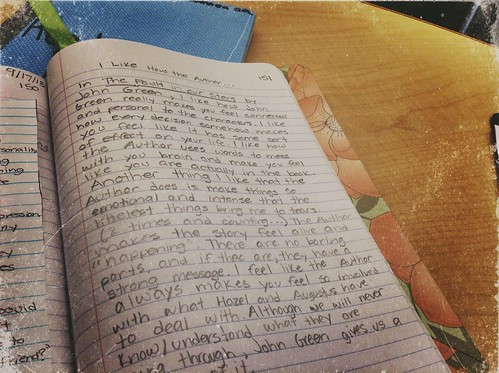
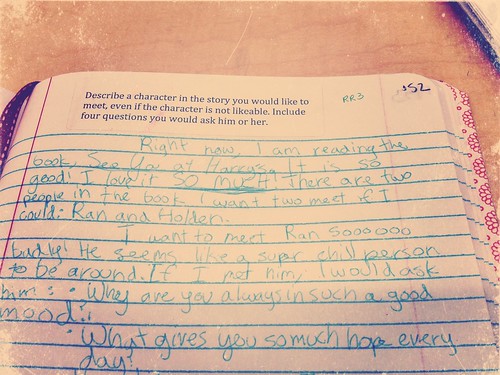
Our reading and writing notebooks.

During NaNoWriMo, almost all of our writing time was devoted to working on our novels.

As part of reading, however, we do three types of reading responses each week.

For each installment of A Tale of Two Cities, students answer questions about the assigned reading before we discuss it in class. I post these questions on Edmodo, and they respond using Edmodo's turn in assignment function. Some students write sentences and others write mini-essays. I'm mostly interested in gauging their basic understanding, and it gives me a better idea of who is doing this reading independently and who still needs lots of help.

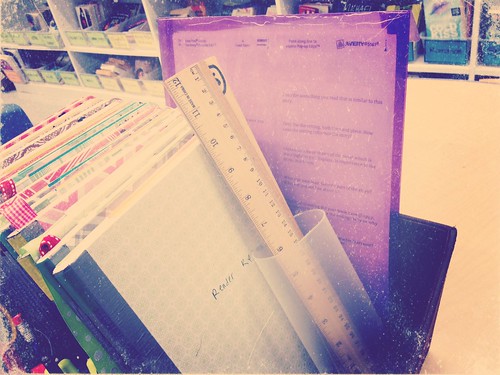
Independent Reading labels

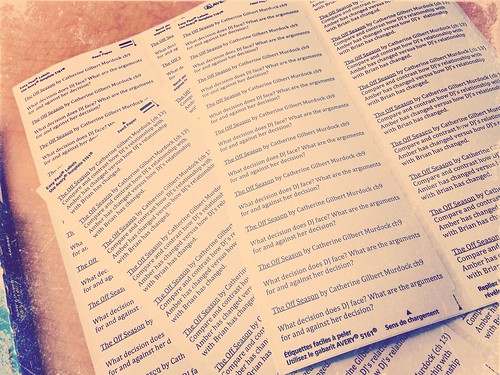
I also ask students to respond to their independent reading each week. Earlier this year I gave each student a sheet of labels with a variety of reading response prompts. (Actually, I made them last year but we only used a few. I reused the sheets with my new class.) Each label has a different prompt, and each student puts their name on the back of a sheet. I like this because students must vary their responses each week. They can't write each week about their favorite character. It also allows them the freedom to match a prompt to their current book, instead of forcing them to adapt a class prompt to their book. Sometimes students respond generically to a specific prompt, and this gives me a chance to address with them the need to keep a specific prompt or writing task in mind when they are answering a question. Finally, my tidy heart appreciates that I can actually read the prompt since it's typed at the top of the page.

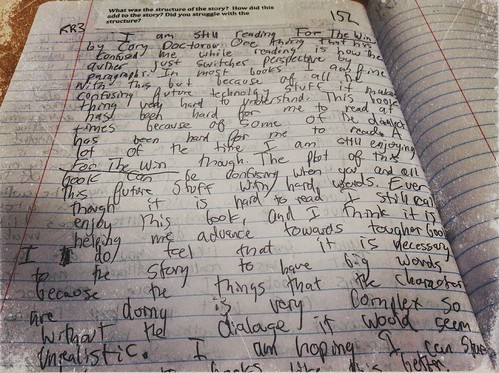
She used an actual prompt, but forgot her label.
Yes, we're working on breaking into paragraphs.
These are good places to rave about books we love.

We have also been answering specific questions to accompany our class read-aloud of Catherine Gilbert Murdock's The Off Season. I hadn't planned on reading this book, but the entire class begged for it. I decided that if we did read it, we would be more deliberate in our approach. I reread it and wrote down prompts every few chapters. Some were emotional responses, and others asked students to notice something specific in the text. For example, the first chapter is about the annual Labor Day picnic, but it ends with DJ the narrator sitting in a hospital, remembering that she used to be happy. On their own, most students read right past this, but I pulled the quote out and asked them to think about it. How is this novel structured? When is the narrative happening? What do you think this means?

Some examples of whole-class prompts.

How do you write about reading in your classroom?

Tuesday, December 3, 2013

So there was this

Setting: 8th grade classroom. November. Students are writing novels. Two girls are laughing manically. One boy suffers quietly at their table.

Boy: "Miss Kelley, did you know what you were doing when you put them next to each other?"
Girl 1: "She put us together on purpose. She thinks it's funny.
Boy: *sighs*
Me: "It's true."
Girls continue to laugh.
Me: "What is so funny?"
Girl 2: "She killed me off in her novel."
Me: "You killed her?"
Girl 1: "It was the sparkle ponies, but don't worry, she's recalled to life."
Silence in classroom.
Boy at other end of room: "Did you just make a Tale of Two Cities reference in your sparkle pony novel?!?"
Girl 2: "Yes I did."
Me: "I love my job."


Sunday, December 1, 2013

Finish that Draft (My #nerdlution)

This year, my students and I had secret word count goals for NaNoWriMo. We also had official, public goals. Our official goals counted toward grades and "winning" on the website, while our secret goals were, well, secret. My official goal, of course, was 50,000 words, and I "won" for the fifth year in a row. (By the way, if you want motivation to finish something, tell seventy 7th and 8th graders what you're doing. That'll motivate you.)

My not-so-secret goal was to write a full draft. My best guess is that this would be in the 60,000 to 90,000 word range. I knew this wouldn't happen during November, especially with NCTE and ALAN at the end of the month, but I also knew that after five years, I wanted to push myself further. I know that I can write 50,000 words in thirty days, but can I write a full draft? Can I remain dedicated after November?

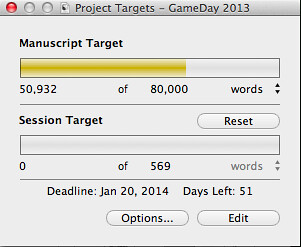
So I already had tentative plans to keep writing when I noticed the conversation that led to the #nerdlution hashtag. And, happily for me, the timing is perfect. I won't have to write as many words each day, so I can also spend some time mapping out my story. And while I'm going to adjust my project target in Scrivener to 80,000 words by January 20, I won't have to spend every day writing (and writing and writing). Committing to 30 minutes a day might involve writing, but it will also be planning and plotting and adjusting and doing all the other important writer tasks that I don't allow myself to do during November. Perhaps this year I'll end with a draft that I'm willing to let someone else read.

So #nerdlution 1: Finish NaNo draft.

I also want to get back to writing here. The best time for me to do this during the school year is before school, and I confess that I've gotten a little lazy about this. I get up at the same time, but I read or play games instead of writing. When I started this blog, I told myself that pieces could and should be short and unfinished. Sometimes I would set a timer for fifteen minutes and tell myself I was done when the duck quacked. I need to get back to this. My most recent Nerdy post, for example, reminded me that a post can be as simple as sharing a conversation that I had with students.

So while I'm not quite ready to commit to 50 posts in 50 days, I would like to get back to four or five posts in a week. That's #nerdlution 2.

And while not officially a #nerdlution, December 1 is also a good time to revisit some of my reading goals for 2013. I reached 200 books a few weeks ago, but my other goals could use some work. I won't read as many professional books or #nerdprintz books in 2013 as I would have liked, but I can commit to one teaching book and two #nerdprintz this December. I also wanted to read fifty books that I already owned, and as of today I've read thirty (though my recordkeeping here might be flawed). Again, I won't reach fifty, but I will expand my goal to include books from last spring and summer that I haven't read yet. I also need to pick up Middlemarch again before I forget everything I already read. I like it, a lot, but it's hard to find time when I'm also prepping A Tale of Two Cities each week.

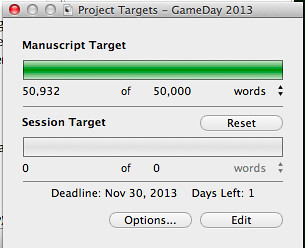
Time to reset my project counter:

*cries*


Monday, November 4, 2013

A "normal" week?

The last few weeks have been one thing after another. I traveled. The school hosted our rummage sale, so we had classes in the church and in the hallway. We had 8th grade conferences. It was Halloween. I looked at my lesson plans and at the calendar yesterday (yes, I was at school on a Sunday), and I realized that I lost a week somewhere and won't fit in another continent test before I go to Boston for NCTE. Oops.

This week should be calmer. We're learning South America in geography, and finally getting to spend some time discussing the Haitian revolution in history. We're reading The Off Season for our read-aloud, most students have finished Allegiant, and we're actually a month ahead of last year in A Tale of a Two Cities.

And it's NaNoWriMo.

Friday should have been a disaster. It was the day after Halloween. 8th grade was at the high school on Wednesday so we didn't have classes. There was an extra-long mass on Friday. It should have been exhausted chaos.

Instead, there was typing. And when the chicken (timer) would go off, the students would shoot it dirty looks and keep typing.

Who am I to argue with that?

Our new currently reading display. I took this idea from my friend Tony Keefer.


Wednesday, October 23, 2013

Talk

When I first decided to do NaNoWriMo with students four years ago, I used a stealth approach. "We're going to write novels," I whispered, hoping the kids wouldn't notice and freak out.

Now, as we approach our fifth year, it's a regular topic of discussion in the hallways between 7th and 8th graders. "What are you going to write about?" students ask each other. "Miss Kelley, are you going to write a novel?" they ask me as we stand in line for lunch.

In 8th grade we started prepping our novels last Friday. We've been using some of the lessons and ideas found on the YWP website, and I've printed out some of the planning materials. (They did the entire workbook last year.) We've been meeting on our imaginary rug to discuss characters, conflicts, and plot, and then breaking into groups to plan imaginary group novels and to work on individual planning.

That was the plan for yesterday. I wanted to replace some middle school level handouts with high school materials, and then send them off to work on plot. Instead, a student asked about my novel, and I shared my idea, and we spent the remainder of the period sharing our ideas for NaNoWriMo. And it was terrific.

I knew when I decided to answer the question that it would totally throw off our timing. We were already running late because new books arrived during lunch, and nothing was more important than distributing Allegiant immediately. But that twenty minutes of sitting in a circle, sharing ideas, was just as valuable as twenty minutes working independently (or, more likely, trying to read Allegiant without getting caught).

I began by sharing my novel idea, and even told students that I'm going to rewrite from scratch my novel from two years ago. I told them that I got so far behind that year that I wrote over 35,000 words between the end of NCTE Chicago and the end of Thanksgiving break (basically, four days). I asked students what they were going to write, and they shared their plans. There were suggestions for similar books and ideas, questions that helped with plots holes, and plenty of laughs.

In my experience, NaNoWriMo does as much for my students' reading as it does for their writing. When they try to DO as writers something they've done so many times as readers, they really start to understand how story works.

It also leads to conversations like this one:

Female student: "My novel has three main characters, and it's from all their points of view, and they're all antagonists to each other. Does that work?"
Me: "Yeah, sure. I mean Voldemorte is the protagonist of his own story, right.? He doesn't wake up each day and say I'm the antagonist."
Various replies, including a boy who I know wants to argue that Voldemorte does wake up and want to be the antagonist.
Me: "And sometimes, the antagonist and the protagonist can switch places. Like in Stars Wars, Darth Vader is the antagonist in the original trilogy but the protagonist in the prequels. Spoiler alert."
Male student: "Oh, man, I haven't read them yet."
Another male student: "They're movies."
Me: "That came out in the 1970's."
Male student: "Oh. I just figure everything comes from a book."

You can't plan for conversations like that.


Monday, October 7, 2013

Reading Their Writing

I love reading what my students write.

I hate assigning a grade to what my students write.

Unfortunately, refusing to assign grades is not an option. I did stop using rubrics last year, and I don't regret it.

Here's how I handle 'grading' writing now: I read and respond, sometimes marking corrections and always writing a note with what works and what needs improvement. I make a note for myself about one or two writing issues for each student. Writing then falls into one of three categories. Great/You're Done means any changes are minor or just suggestions. I enter 90% in the gradebook. You should redo this/Recommended Redo means the writing should be stronger or there are some mistakes with things we're still practicing in class. The score is an 80%. Required Redo means there are the kinds of obvious mistakes that 8th graders shouldn't be making, or a lack of effort is obvious in the writing. This means the writing doesn't meet the minimum standard for the assignment. The score is 70%. Students can redo any assignment, especially writing, as many times as they need to.

Some of this, of course, is specific to my school and my students. Our grading scale doesn't include pluses or minuses, so a 90% is an A. Although this means an 80% is a B, most students hate having a score that low and will redo it. No one finds a 70% acceptable, so they'll redo that too. And I only have 26 students total this year, so reading student work multiple times is not an impossible task.

This year I'll assign a deadline for resubmitting work, probably a week after the paper is returned to students, and the new grade erases the old one. At times I'll still have too many papers to read, but I can never complain given our class sizes. I remember clearly what it was like to have 150 students and 100+ papers.

How do you handle grading writing?

Thursday, September 26, 2013

Obvious Stuff

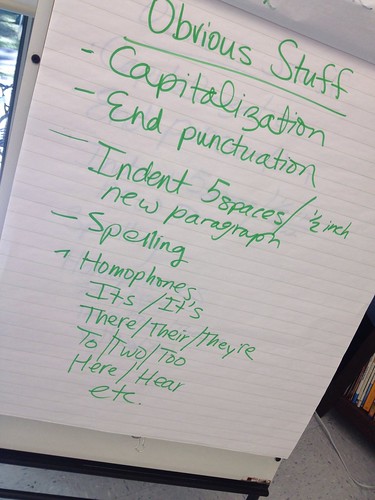
For several years, the first rule of editing in my classroom was "Obvious stuff." I think I took this term from Nancie Atwell. At some point, I realized that what was obvious to me was not obvious to 14-year-olds, and the Obvious Stuff chart was born.

Our messy list created in class.

I think my first list years ago was longer, but this is the list we made in class together this week. The other section came up with a remarkably similar list. Later today I will rewrite this more neatly and clarify each item.

Like our "Old Rules for Commas" list, these are items that need to become automatic. Students need to be able to follow these conventions on timed writings. As an adult, they'll be expected to follow these rules in work emails. Mistakes with obvious stuff can kill a job application.

(Quick aside: One of my 8th graders asked if I follow all the conventions in text messages. I said I do, to the point of using semicolons while texting. She expressed her frustration with this. She said she hates it when people waste time with periods in text messages. Not that she's too lazy, or can't remember, but that she thinks the convention of texting should be no end punctuation, just keep writing. It's something to think about.)

For me, though, the beauty of Obvious Stuff is that it forces me to make explicit some of the things that we as teachers tend to assume that everyone should know how to do. When we were making the chart, one student suggested punctuation, and I talked her around to end punctuation. End punctuation, we all agreed, should be obvious. Commas are not.

Are there conventions in your classroom that are obvious only to you? It's something to consider.

Thursday, September 12, 2013

Where the Commas Go

Several years ago, a fellow teacher was asked by a parent if her son knew "where the commas go." This was repeated to me later, and I don't remember the details, but that question sticks with me: "Does my child know where the commas go?" It is the kind of question that often gets asked when someone is objecting to writing workshop, or to a lack of grammar worksheets and tests.

At the time, my students and I would joke that there are at least ninety-nine rules for where the commas go. Some are easy, and others are super challenging, some automatic, others up for debate.

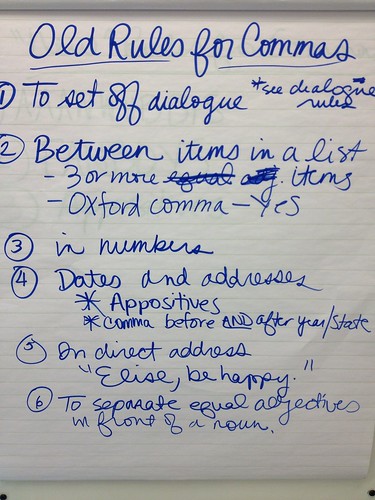
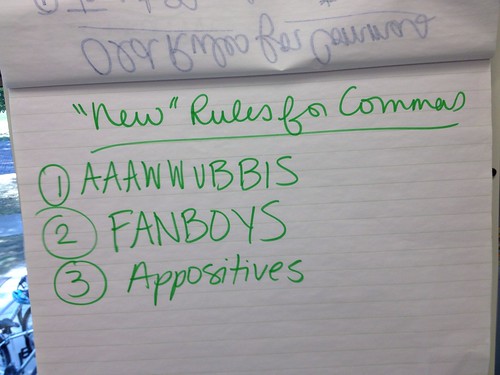
Last year I shared grammar duties for 8th grade with another teacher, so to keep things straight we made two charts: Old Rules for Commas and New Rules for Commas. We expected our students to apply the old rules without fail, every single time. Like the editing checklists we had used previously, we expected students to independently find and fix any mistakes related to the old rules. Our other list, the new rules, were the rules we were still learning and practicing. They might get those wrong, but they were working on them. The rules themselves are nothing fancy to start; I know from reading Mechanically Inclined that Jeff Anderson used them with fourth graders. Many students master the new rules quickly, while others need a few more weeks. That's okay.

(An 8th grader close to graduating once confessed to me that he didn't understand the difference between to, too, and two. It happens. It's never a mistake to spend 5 minutes reviewing something you only think everyone already knows.)

Yesterday my students gathered on our imaginary rug, and we made our lists of old and new rules. For now, I kept rules relating to phrases and clauses on the new list; I'm not convinced that those rules are automatic enough for everyone. Our old rules are so basic that I won't feel guilty expecting perfection in using them.

Yes, this is how messy a chart is when I make it in class.

Later today I will take the lists that I made with each section, and make a chart with some details and examples for each rule. Students will copy that chart into their Writer's Notebooks. And when we revise and proofread, I'll point to the old list for commas and say "Make sure you follow these rules!"

Go ahead, pin this. I dare you.

This year I put "new" in quotes. They worked on AAAWWUBBIS and FANBOYS last year, but I want to revisit them before we move on. Each rule will get a page in their notebooks, with examples, and they'll write their own sentences on the facing page, another idea adapted from Mechanically Inclined. This way, when someone doesn't know how to punctuate something, they can either look at the wall or in their notebook. When we start working in our Killgallon book (Grammar for Middle School: A Sentence-Composing for Approach), we'll add those sentence types, and their comma rules, too.

How do you teach commas in your classroom?


Thursday, August 29, 2013

Blank Walls and Anchor Charts

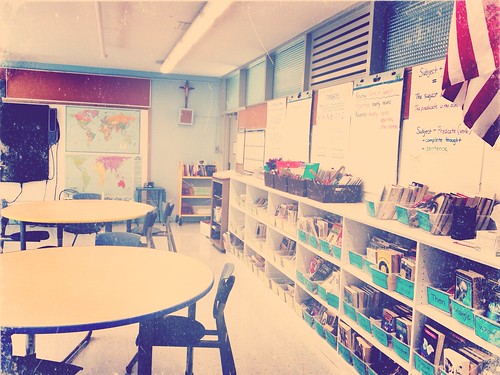
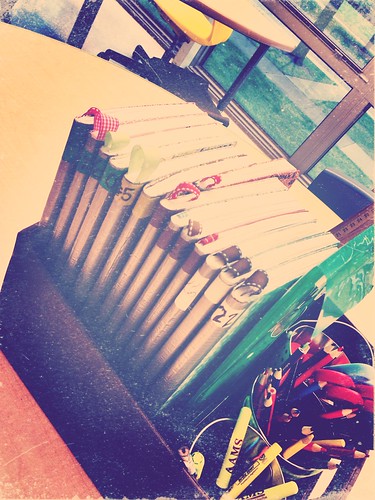
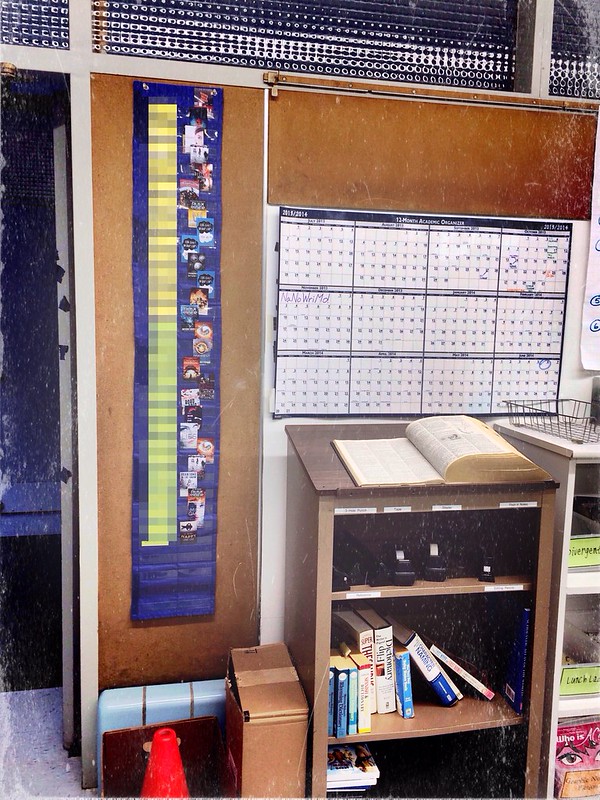
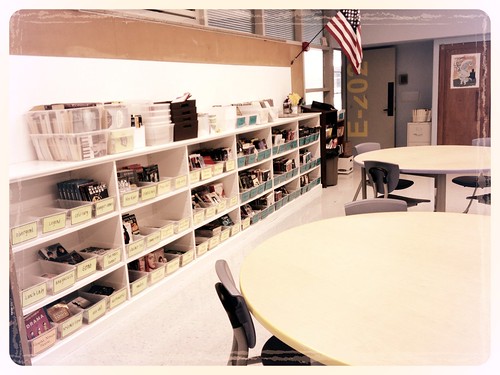
As I mentioned a few times, I like to start the year with primarily blank walls and bulletin boards, like this:

Empty bins = most popular summer titles.

I'm a big believer in making your charts in front of your students, even if I often have to go back and clean them up (or choose new colors). They still recognize the thinking and talking that we did in class on the walls.

I'm also very much against isolated grammar instruction. I don't do worksheets or sentence diagramming. We don't color code parts of speech. However, the reality is that I teach 8th grade, and some of my students will have cranky grammarians for high school teachers. My students need a grammar vocabulary that isn't necessarily useful in the world at large, but will be essential in the next few years.

If you haven't read Mechanically Inclined by Jeff Anderson, then go get it right now. Even though his students in the book are 4th graders, it will help anyone who is trying to integrate writing and grammar/mechanics.

I use the book Grammar for Middle School: A Sentence-Composing Approach by Don Killgallon with my students. The grammar is pretty fancy (gerunds! absolute phrases! appositives!), but instead of endless drilling, we practice using new types of sentences to expand our skills. (I need to write a longer post on how I use this book when I have more time. I definitely don't follow the order of sentence types in the table of contents.)

I realized a few years ago that this would only work if my students memorized the difference between a phrase and a clause. Even if they still struggle to recognize or use them well, I needed the definition to be automatic, like math facts. I wrote a simple, nine-question test, gave them the key, and had them commit the answers to memory. Last year they ended 7th grade with this test, and so on Tuesday (and Thursday as I have a slightly goofy schedule this year), they took it again. When they were done, I had them switch pens, and I wrote the answers on chart paper on our easel. (They were messy, messy charts. I'm sorry I forgot to take a picture.) Once both classes were done, I spent some time after school copying the messy info into something that they can copy into their writer's notebooks.

I'm not capable of making charts fancier than these.

I will leave these charts hanging until the test next week, and then put them up again until we need the space for something else.

This is much better than anything I could have done with butcher paper.

Messy anchor charts start here.