Showing posts with label Grammar. Show all posts

Thursday, September 19, 2013

It Could Be Worse

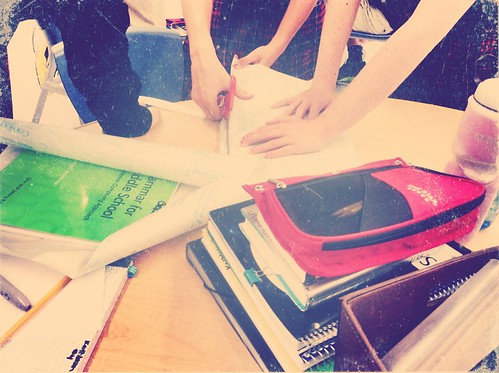
Tuesday was one of the more hilarious days of the year in 8th grade humanities.

It was cover-the-grammar-book-with-contact-paper day.

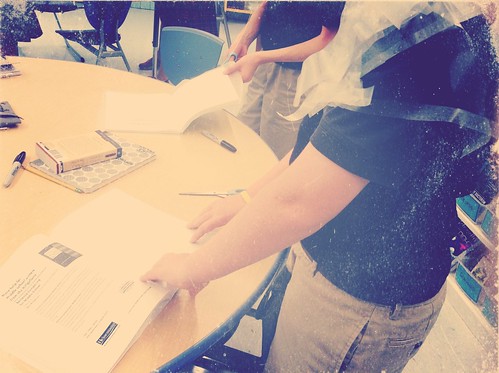
If you've never had students cover their books with contact paper before, then you're in for a treat. Inevitably, someone ends up with the paper wrapped around her arm. Someone folds the paper in on itself. Someone becomes obsessed with air bubbles and compulsively tries to get rid of them. A girl who does everything perfectly will be terrible at this, and a boy will surprise you by being the best in the class. And this will happen:

It's worth the fifteen minutes. The books will have a cover all year, and you will end up only covering three or four books (you'll take pity on a few kids) instead of twenty or thirty. A memory will be made. Whenever you need to have your students do something difficult, just remind them of the contact paper.

They'll stop complaining.

Thursday, September 12, 2013

Where the Commas Go

Several years ago, a fellow teacher was asked by a parent if her son knew "where the commas go." This was repeated to me later, and I don't remember the details, but that question sticks with me: "Does my child know where the commas go?" It is the kind of question that often gets asked when someone is objecting to writing workshop, or to a lack of grammar worksheets and tests.

At the time, my students and I would joke that there are at least ninety-nine rules for where the commas go. Some are easy, and others are super challenging, some automatic, others up for debate.

Last year I shared grammar duties for 8th grade with another teacher, so to keep things straight we made two charts: Old Rules for Commas and New Rules for Commas. We expected our students to apply the old rules without fail, every single time. Like the editing checklists we had used previously, we expected students to independently find and fix any mistakes related to the old rules. Our other list, the new rules, were the rules we were still learning and practicing. They might get those wrong, but they were working on them. The rules themselves are nothing fancy to start; I know from reading Mechanically Inclined that Jeff Anderson used them with fourth graders. Many students master the new rules quickly, while others need a few more weeks. That's okay.

(An 8th grader close to graduating once confessed to me that he didn't understand the difference between to, too, and two. It happens. It's never a mistake to spend 5 minutes reviewing something you only think everyone already knows.)

Yesterday my students gathered on our imaginary rug, and we made our lists of old and new rules. For now, I kept rules relating to phrases and clauses on the new list; I'm not convinced that those rules are automatic enough for everyone. Our old rules are so basic that I won't feel guilty expecting perfection in using them.
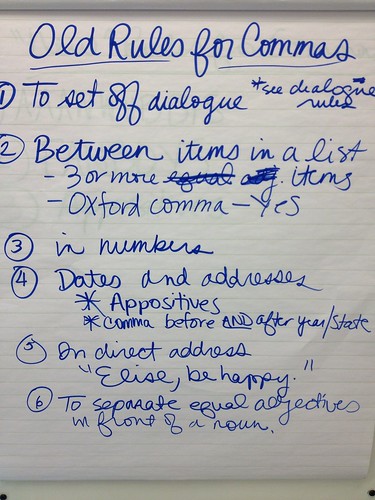
Yes, this is how messy a chart is when I make it in class.

Later today I will take the lists that I made with each section, and make a chart with some details and examples for each rule. Students will copy that chart into their Writer's Notebooks. And when we revise and proofread, I'll point to the old list for commas and say "Make sure you follow these rules!"
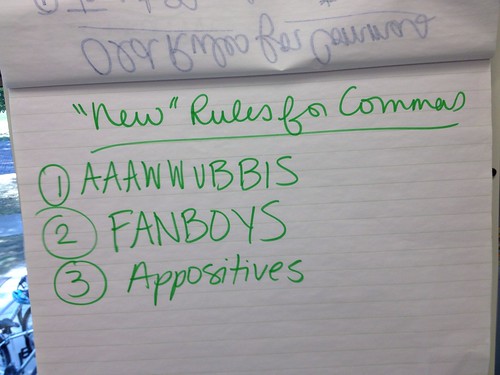
Go ahead, pin this. I dare you.

This year I put "new" in quotes. They worked on AAAWWUBBIS and FANBOYS last year, but I want to revisit them before we move on. Each rule will get a page in their notebooks, with examples, and they'll write their own sentences on the facing page, another idea adapted from Mechanically Inclined. This way, when someone doesn't know how to punctuate something, they can either look at the wall or in their notebook. When we start working in our Killgallon book (Grammar for Middle School: A Sentence-Composing for Approach), we'll add those sentence types, and their comma rules, too.

How do you teach commas in your classroom?
 

Thursday, August 29, 2013

Blank Walls and Anchor Charts

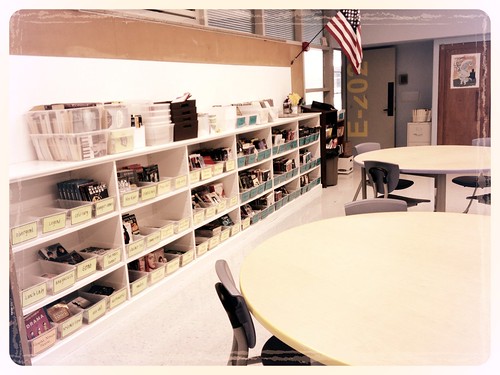
As I mentioned a few times, I like to start the year with primarily blank walls and bulletin boards, like this:

Empty bins = most popular summer titles.

I'm a big believer in making your charts in front of your students, even if I often have to go back and clean them up (or choose new colors). They still recognize the thinking and talking that we did in class on the walls.

I'm also very much against isolated grammar instruction. I don't do worksheets or sentence diagramming. We don't color code parts of speech. However, the reality is that I teach 8th grade, and some of my students will have cranky grammarians for high school teachers. My students need a grammar vocabulary that isn't necessarily useful in the world at large, but will be essential in the next few years.

If you haven't read Mechanically Inclined by Jeff Anderson, then go get it right now. Even though his students in the book are 4th graders, it will help anyone who is trying to integrate writing and grammar/mechanics.

I use the book Grammar for Middle School: A Sentence-Composing Approach by Don Killgallon with my students. The grammar is pretty fancy (gerunds! absolute phrases! appositives!), but instead of endless drilling, we practice using new types of sentences to expand our skills. (I need to write a longer post on how I use this book when I have more time. I definitely don't follow the order of sentence types in the table of contents.)

I realized a few years ago that this would only work if my students memorized the difference between a phrase and a clause. Even if they still struggle to recognize or use them well, I needed the definition to be automatic, like math facts. I wrote a simple, nine-question test, gave them the key, and had them commit the answers to memory. Last year they ended 7th grade with this test, and so on Tuesday (and Thursday as I have a slightly goofy schedule this year), they took it again. When they were done, I had them switch pens, and I wrote the answers on chart paper on our easel. (They were messy, messy charts. I'm sorry I forgot to take a picture.) Once both classes were done, I spent some time after school copying the messy info into something that they can copy into their writer's notebooks.

I'm not capable of making charts fancier than these.

I will leave these charts hanging until the test next week, and then put them up again until we need the space for something else.

This is much better than anything I could have done with butcher paper.

Messy anchor charts start here.